

Gender EqualityIndex
Commitment to Gender Equality
Committed to professional equality between women and men, SEDI-ATI presents the results of its 2025 index.

Current legislation
Professional equality between women and men is a major social and performance issue for companies.In accordance with current legislation, every year since 2019, companies with 50 or more employees must measure professional equality between the sexes using a professional equality index.This index, which measures professional equality between women and men on a scale of 100 points, is based on four indicators:
- Indicator 1 – Gender pay gap (40 points);
- Indicator 2 – Individual pay rise gap (35 points);
- Indicator 3 – Percentage of employees receiving a pay rise on returning from maternity leave (15 points);
- Indicator 4 – Number of employees of the under-represented gender among the ten highest paid employees in the company (10 points).
The index must be published annually and monitored over three years by companies. The target is to achieve a score of 75 out of 100, and action plans are drawn up each year to achieve this.
The results of our 2025 index
SEDI-ATI is fully committed to this approach, and we are proud to present the results of our index for the year 2025. The professional equality index is based on several objective criteria and allows us to track progress made each year. We firmly believe that transparency and accountability are essential to achieving true equality, and we are committed to continuing our efforts to reduce inequalities and promote a more inclusive corporate culture.
For this monitoring, our company has chosen to use the calendar year as the reference period, i.e. from 1 January to 31 December of the year preceding publication. We invite you to discover the detailed results of our index here, as well as the concrete actions we are implementing to achieve our professional equality objectives.
Due to insufficient staff numbers to calculate all the regulatory indicators, the overall index score cannot be calculated for the year 2025.
The following indicators can be calculated:
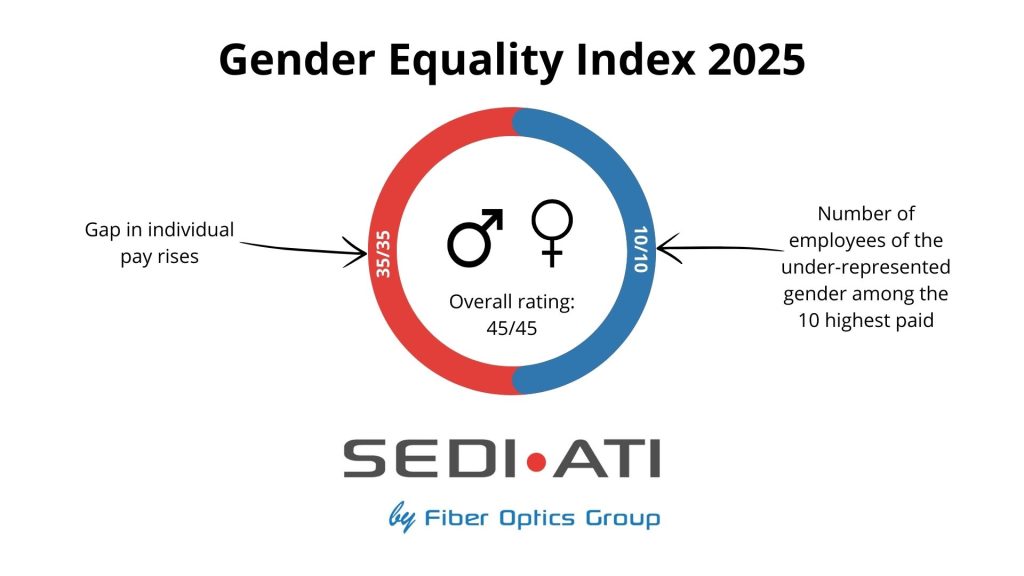
Indicator 2 – Gap in individual pay rises: 35/35
Indicator 4 – Number of employees of the under-represented gender among the 10 highest paid: 10/10
The other indicators cannot be calculated because the distribution of the workforce does not allow for statistically usable groups to be obtained in accordance with the rules laid down by the regulations.