


DosimeterRadiology
Scintillating optical fiber solution for radiology dosimetry
SEDI-ATI designs scintillating fiber optic probes for dosimeter applications applied to radiology.


MajorContraints
- Extreme and confined environments with X-rays and Gamma-rays,
- Robustness to support the patient’s weight,
- Real time mapping with ultra-compact invisible devices,
- Very low bending radius with scintillating optical fibers.
TheChallenge
Quantify the level of radioactive exposure received by a patient during a radiological examination (CT or IRM scan).
A societal issue: measuring the radiation dose rate received by the patient
X-rays are nowadays essential in the characterization and metrology of materials, objects and living species, as well as in certain therapies such as cancer therapy for example. One of today’s societal challenges is the quantification of the level of radioactive exposure of the patient during a radiological examination such as a CT or MRI scan.
The idea is to place an ultra-compact and flexible X-ray detector either under or inside the mattress, or even in the headrest, of the examination table where the patient stands.
Radiation sensors based on scintillating and plastic optical fibers
Two solutions are being studied. The first one consists in a fibered probe, of a 500 µm plastic optical fiber and a 500 µm scintillating X-ray sensitive fiber optic section.
The second one is a woven mesh of scintillating optical fibers, which could in addition make it possible to very finely locate the position where the radiation was received.
A unique know-how: splicing between different types of large core optical fibers
SEDI-ATI has a long experience on splicing scintillating optical fibers with plastic optical fibers on both ends to perform a radiation probe. SEDI-ATI has mastered the mechanical process to make a splice on this type of fiber. The junction between the two fibers (plastic and scintillating) is then protected by a stainless steel tube. The splicing between the two fiber types, having a similar 500 µm diameter, is not feasible by fusion but needs to be done by a mechanical process.
NANOPTiX: a pioneering program of the ANR
Thanks to its notoriety on scintillating fibers, SEDI-ATI is the industrial partner in the NANOPTiX project of the French National Research Agency [ANR]. The research project aims to develop the next generation of miniaturized X-ray sensors with faster response time, higher sensitivity and crosstalk free.
This project targets tiny X-ray probes integrated at the end of narrow fibers of the size of a human hair. To this end, NANOPTIX will exploit, for the first time, the concept of Nano-Optical Antenna (NOA) for controlling the X-ray excited luminescence (XEL) from scintillators.
For further information, read the publication ‘Seven-probe fiber detector for time-resolved source tracking in HDR-brachytherapy: Pre-clinical experimental evaluation‘ published in the journal Medical Physics, Volume 52, Issue 11, November 2025.
This article highlights the pre-clinical experimental evaluation of a 7-probe scintillator detector (7SD) for real-time monitoring of high-dose-rate brachytherapy (HDR-BT) treatments.
The pre-clinical evaluation demonstrated that the 7SD will improve patient safety thanks to its ability to detect radioactive source positioning errors in real time with sub-millimetre accuracy, as well as to monitor radiation dose levels delivered during very short exposure times (0.1 to 19.5 s).
Cytotoxicity tests were performed to confirm the biocompatibility of 7SD: no significant cytotoxicity was detected. 7SD is compatible with standard needles and catheters, which will facilitate its integration into clinical practice.
Conclusion: 7SD demonstrates significant potential for clinical use in HDR brachytherapy.
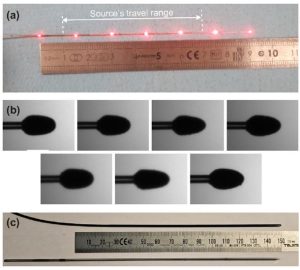
The 7SD. (a) Photograph of the 7SD, with the source travel range considered in this study indicated. (b) Microscope images showing the seven tip-integrated scintillation micro-cells composing the 7SD. (c) Photograph of the encapsulated 7SD alongside a commercial HDR-BT interstitial metallic needle for size comparison.
Key players in the project: the French National Research Agency (ANR), SATT SAYENS, Institut FEMTO-ST and Miguel Angel SUAREZ, the Centre Georges François Leclerc (CGFL) and Mathieu GONOD, SEDI-ATI and Samir LASKRI.
SEDI-ATISolution
The dosimeter for radiology integrates a radiation probe consisting in a 500 µm scintillating fiber spliced on both ends to 500 µm plastic fibers, and placed beneath or even inside the patient’s mattress
AdvantagesSEDI-ATI Solution
- Opacity of the protection coating of the optical fibers against parasitic emissions (ambient light, neon light…).
Related product
-
Radiation-resistant fiber optic cables
Optical fibers gather numerous advantages encouraging to integrate them in applications with radiative environments, associated with the civil, space or defense fields.